
Compost, Food, and Yard Waste
Public Works | Solid Waste Division
Use this page to learn about composting, healthy soil, workshops, and where you can find compost for your garden.
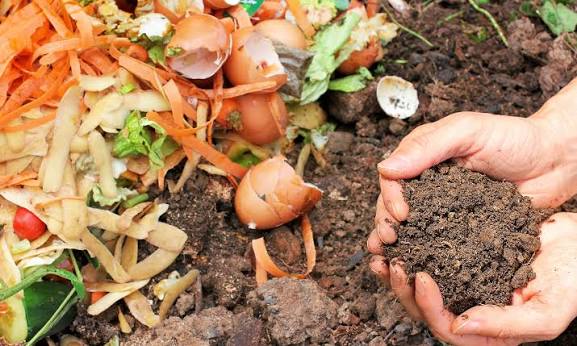
Composting is nature’s way of recycling. In your hands, compost is dark and crumbly. Near your nose, it smells sweet. Compost is the basis for the Earth’s creation of soil.
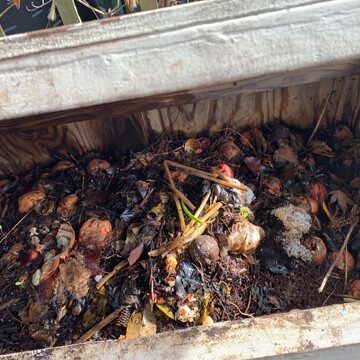
Whenever a plant or animal dies, its remains decay with the help of soil microorganisms and larger soil critters. Over time, they turn into an earth-like substance. Composting plays a huge role in your garden.
- Compost builds good soil structure.
- Compost helps dry soil hold moisture.
- Compost helps release nutrients in forms plants can use when they need them most.
- Compost improves aeration.
- Compost neutralizes toxins in the soil.
- Compost stops erosion.
- Compost suppresses weeds.
"If I wanted to have a happy garden, I must ally myself
with my soil; study and help it to the utmost, untiringly.
Always, the soil must come first."
Marion Cran, If I Were Beginning Again


Compost builds good soil structure. It is also a big step toward recycling waste, saving energy, and regaining control of your food supplies.
Why throw food peelings and yard clippings into the garbage when you can harvest their nutrients by turning them into soil-enriching compost? Learn the best composting method for your backyard.
Learning the Language of the Soil Food Web
You are in a life-dependent exchange with the soil under your feet, whether you like it or not. You depend on healthy soil to support plant life, which is the source of your food and oxygen. Soil is a complex living system.
Plants need basic raw materials like minerals and sugars to stay healthy. You do too. Soil creatures like beetles, bacteria, fungi, and worms create conditions that allow plants and people to absorb these nutrients.
"If a healthy soil is full of death, it is also full of life: worms, fungi, microorganisms of all kinds … given only the health of the soil, nothing that dies is dead for very long."
Wendell Berry
The Unsettling of America (1977)
When leaves, dead insects, manure, and food scraps break down, they return important materials to the soil. This life cycle lets nutrients flow from soil to plant. It moves forward only with the help of the microorganisms and other creatures that make up the soil community.
Soil critters maintain the fertility of the soil. Getting to know these “friends” can be fun. Befriend the garden bug and you are set to inherit good earth.
Take a home composting workshop offered by Skagit County Public Works, Solid Waste Division. Workshops happen several times each season. Callie Martin, Waste Reduction/Recycling Education Specialist for the Solid Waste Division for Skagit County, teaches the workshops.
She is a lifelong practitioner of healthy soils and organic gardening. With a background in Modern and Classical Languages and Environmental Education from Western Washington University, Callie teaches workshops with a history of varied teaching experiences, some of those abroad. She brings a lot of enthusiasm to her work as a compost educator.
Learn how easy it is to compost your food scraps by using worms in an upcoming vermicomposting workshop. Class participants learn the basics of worm bin design, care, and feeding.
If you are interested, you can purchase supplies on a materials list and build your own indoor worm bin as part of the class.
Yards are fun, beautiful, and great spaces for relaxing. However, in taking care of them, you often use water inefficiently, produce a lot of waste, and overuse chemicals that are bad for the environment and your family’s health.
By working with nature in your yard, you can have a great looking landscape that is easier to care for and healthier for families, pets, wildlife, and the Northwest environment.
Use these resources to learn how to buy and use compost, and find local compost sources.
Buying and Using Compost (PDF)
You can purchase high-quality, made-in-the-Skagit-Valley compost from several local sources:
- Daizen Farms, 17636 State Route 20 W., Burlington. $4.50 per 25-pound bag, 100% chicken manure organic dry compost.
- Dykstra Farms, 19111 Gear Road, Burlington. 757-6376. $30 per yard loaded on your pickup.
- Skagit Soils, 13260 Ball Road, Mt. Vernon. 424-0199. $17 per yard, load your own; $19.50 per yard delivered, minimum 10 yards.
- Sun Land Bark and Topsoils, 12469 Reservation Road, Anacortes. 293-7188. $33.25 per yard, Cedar Grove compost; $30 per yard, chicken compost; $30.50 per yard nutria-mulch mix of animal and wood compost. Can deliver.
- Town of La Conner Wastewater Facilities, 12154 Chilberg Road, La Conner. Load your own for free any time you want; $5 to $13 per yard loaded by a tractor.
- Worm Wranglers of Skagit County, 13913 Avon Allen Road, Mount Vernon. (360) 424-8006. Sells vermicompost and red wriggler composting worms; $20 per pound.


